
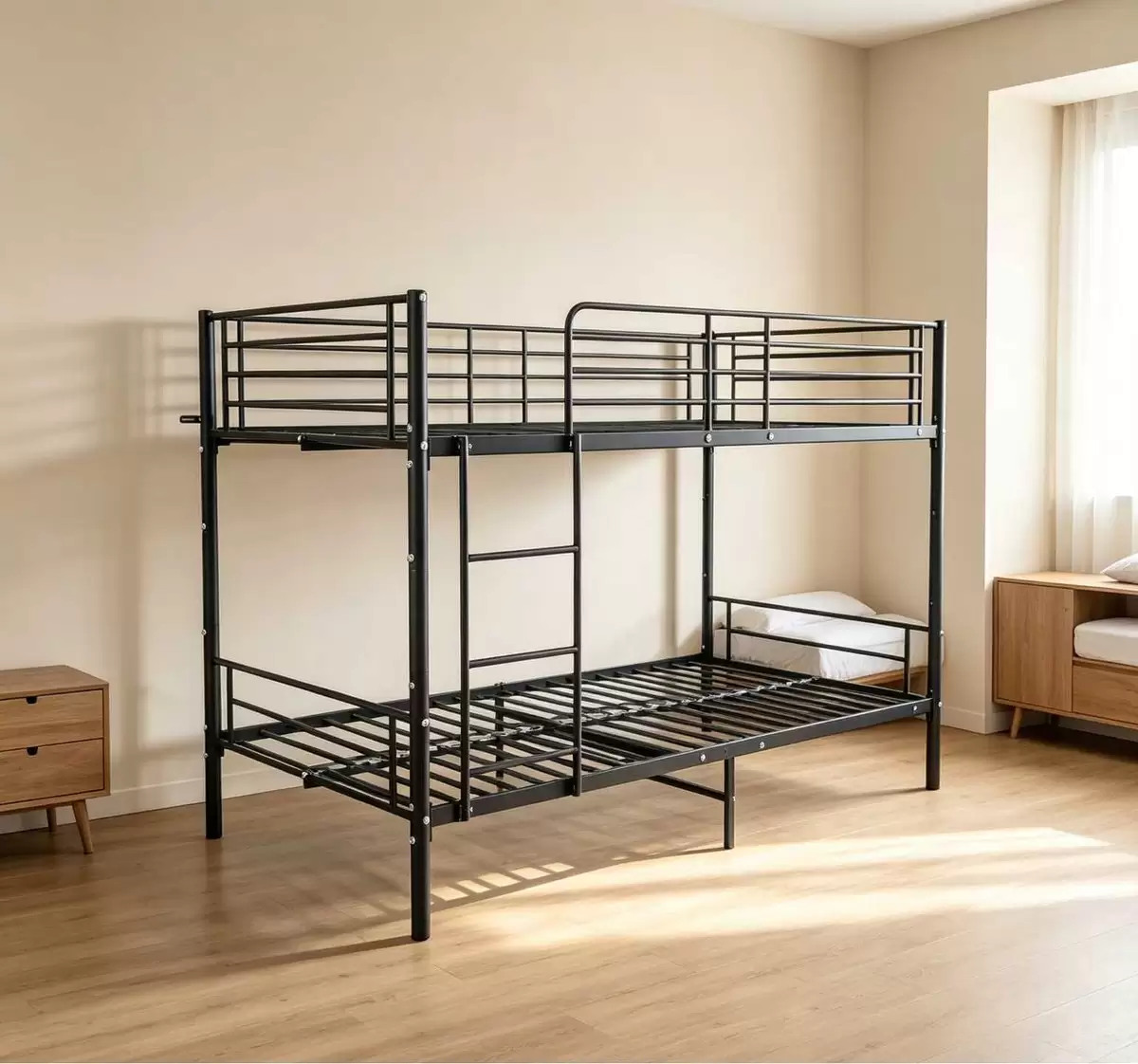
Our steel bunk bed (model 40025) has been tested to EN 747-1:2012+A1:2015 by TÜV SÜD and passed all applicable clauses — bed base, safety barriers, ladder, frame fastenings and stability. This page lists the verified test data, product specifications and knock-down (KD) packing details, so bulk buyers can evaluate the product against the standard itself, not against marketing claims.
What Is EN 747 — and Why It Matters for Bunk Bed Buyers
EN 747 is the European safety standard for bunk beds and high beds. The current version, EN 747-1:2012+A1:2015, defines safety, strength and durability requirements; EN 747-2:2012+A1:2015 defines the test methods. It covers four risk areas that matter most in daily use:
- Entrapment — holes, gaps and openings are checked so heads, limbs and fingers cannot get trapped (tested with conical templates).
- Fall protection — minimum guard rail height above the bed base, and a maximum mattress thickness so the mattress top stays below the rail.
- Strength and durability — static loads, impact tests and thousands of load cycles on the bed base, safety barriers and ladder.
- Stability — the complete bed must resist tipping under defined loading.
For importers, wholesalers and project contractors, a valid EN 747 test report from an accredited laboratory (TÜV SÜD, SGS, Intertek, etc.) is the standard evidence European distributors and institutional buyers ask for before listing or specifying a bunk bed.
TÜV SÜD Test Report: The Data Behind This Bunk Bed
The bunk bed shown on this page was tested at TÜV SÜD Certification and Testing (China) Co., Ltd., Shanghai Branch (an ISO/IEC 17025 laboratory). Test report No. 70.404.23.12820.01, dated 10 January 2024, destination market: Germany. Result: Pass on all tested clauses.
| Test Item (EN 747-2 method) | Requirement Applied | Result |
|---|---|---|
| Bed base static load | 1,200 N downward / 500 N upward, 10 × 30 s | Pass |
| Bed base impact | 25 kg impactor, 180 mm drop height, 10 cycles | Pass |
| Bed base durability | 1,000 N vertical force, 10,000 cycles | Pass |
| Safety barrier static load | 200 N up / 500 N out / 500 N in / 1,000 N down, 10 × 30 s each | Pass |
| Guard rail height | 317 mm above bed base; mattress top 160 mm below rail upper edge | Pass |
| Entrapment gaps (barriers) | 60–75 mm clear spacing between retaining elements | Pass |
| Ladder tread static load | 1,200 N vertical, 10 × 30 s | Pass |
| Ladder durability | 1,000 N, 1,000 cycles | Pass |
| Tread impact | Impact height 150 mm, 10 cycles | Pass |
| Stability | EN 747-2 clause 5.7 | Complied |
| Upper-to-lower bed fastening | 500 N upward static force, 1 × 30 s | Pass |
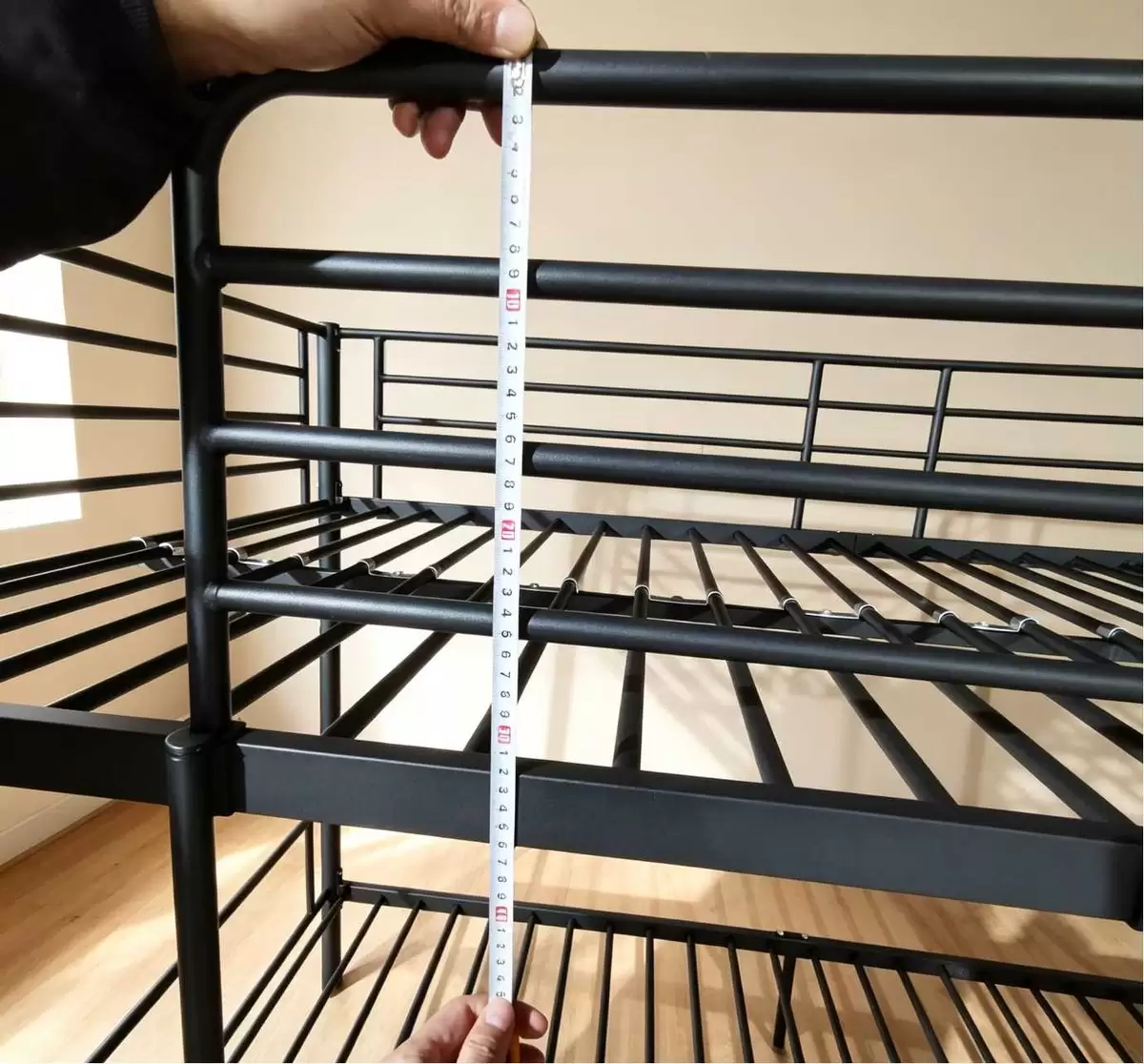
Measured on the production sample: guard rail upper edge sits 317 mm above the bed base (photo), keeping the mattress top 160 mm below the rail — the fall-protection geometry EN 747 requires.
Note on scope: EN 747 verifies structural safety under the standard's defined loads. Our standard berths are additionally load-tested by SGS to 200 kg per level — two separate evidence sets, both available to serious buyers.
EN 747 Bunk Bed Specifications (Tested Model 40025)
| Item | Specification |
|---|---|
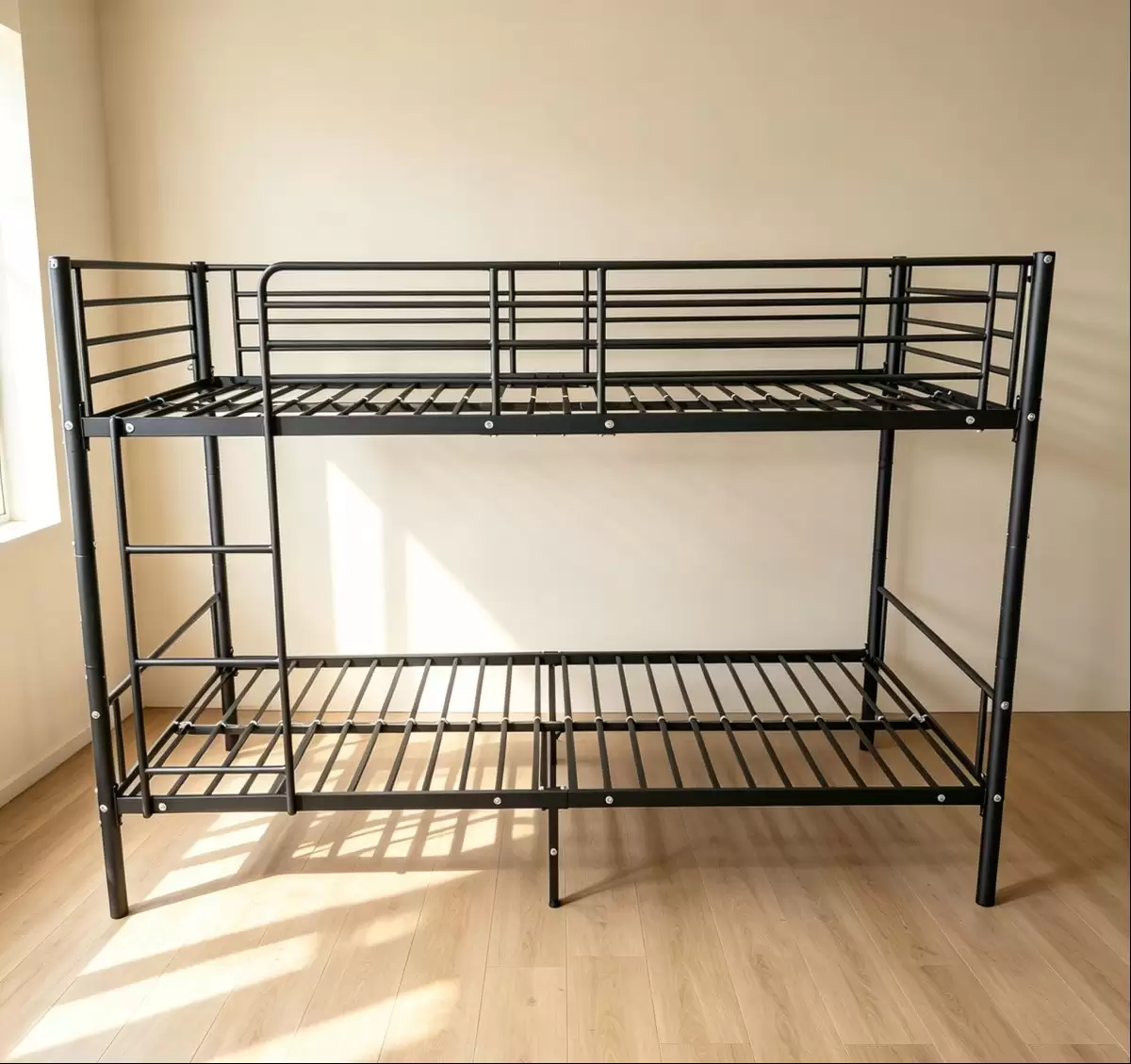
| Overall size (L × W × H) | 2,090 × 1,080 × 1,500 mm |
| Net weight | 39.0 kg per set |
| Frame material | Cold-rolled steel tube, 0.8–1.2 mm wall thickness (thickenable for heavy-duty projects) |
| Finish | Anti-rust powder coating; black / white / grey standard, RAL colors on volume orders |
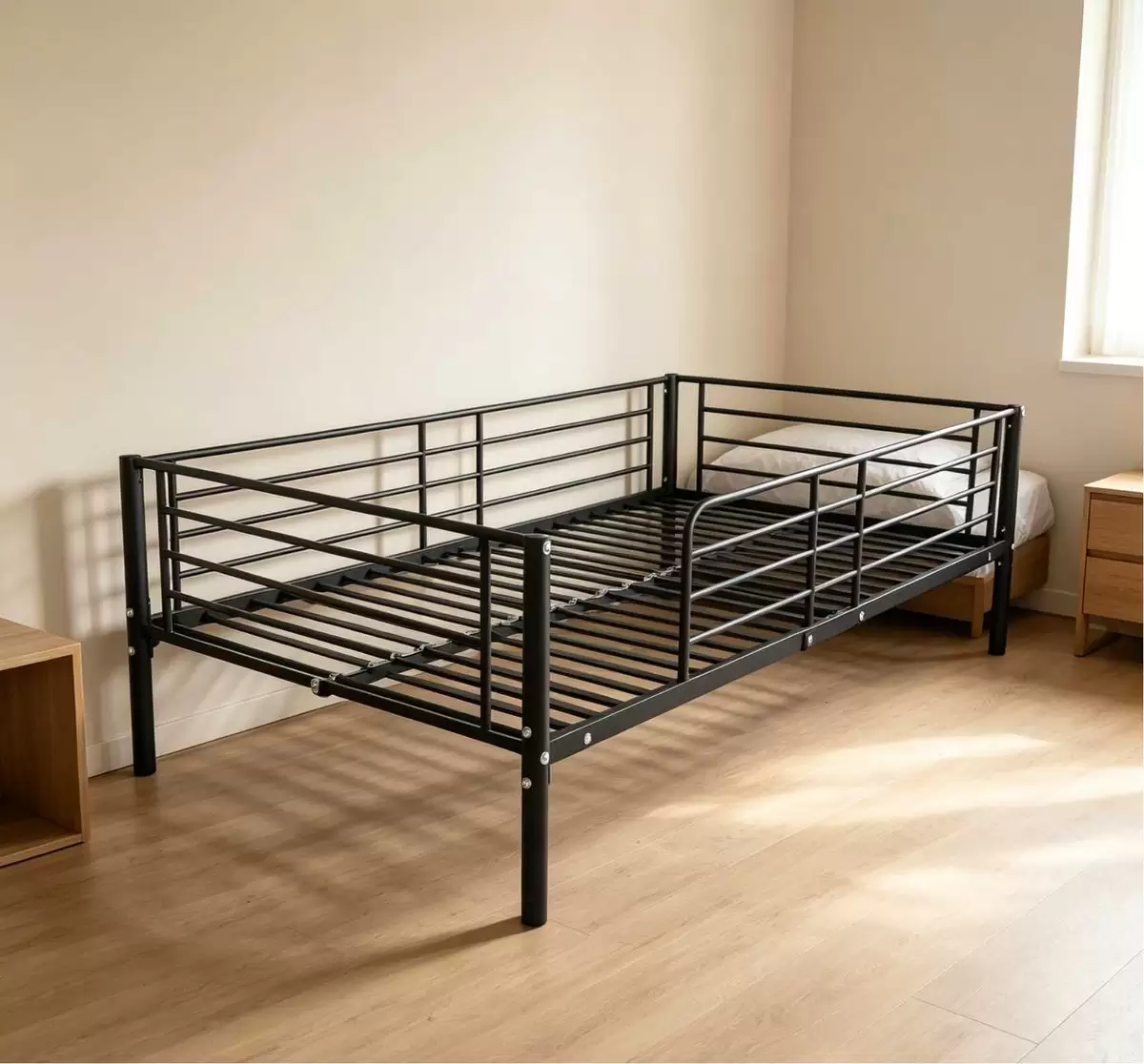
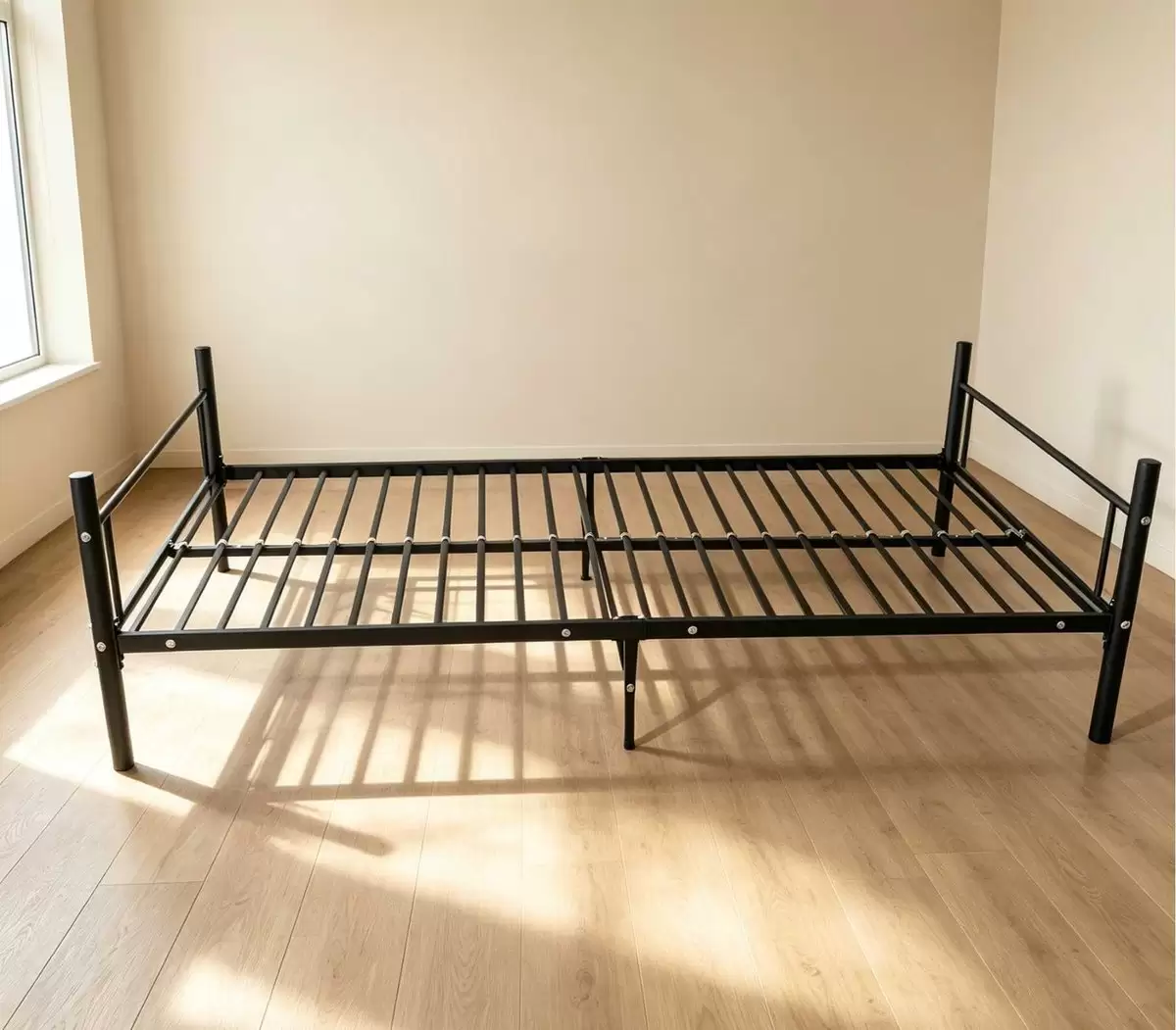
| Design | Knock-down (KD), bolt-together construction, can be separated into two single beds |
| Packing | 5-layer export carton + foam corners, flat-packed |
| MOQ | 50 sets standard; sample orders of 1–5 sets accepted |
| Lead time | 25–30 working days after deposit |
| Payment | 30% T/T deposit + 70% against B/L copy |
| Trade terms | FOB / CIF / CFR from Tianjin Xingang, China |
Knock-Down (KD) Design Built for Container Shipping
The same features that make this bunk bed pass EN 747 also make it efficient to ship. The frame is fully bolted — no welded one-piece structure — so each set packs flat into a 5-layer export carton with foam corner protection. At 39.0 kg per set, a 40ft container carries a high quantity per shipment, which directly lowers your landed cost per bed.
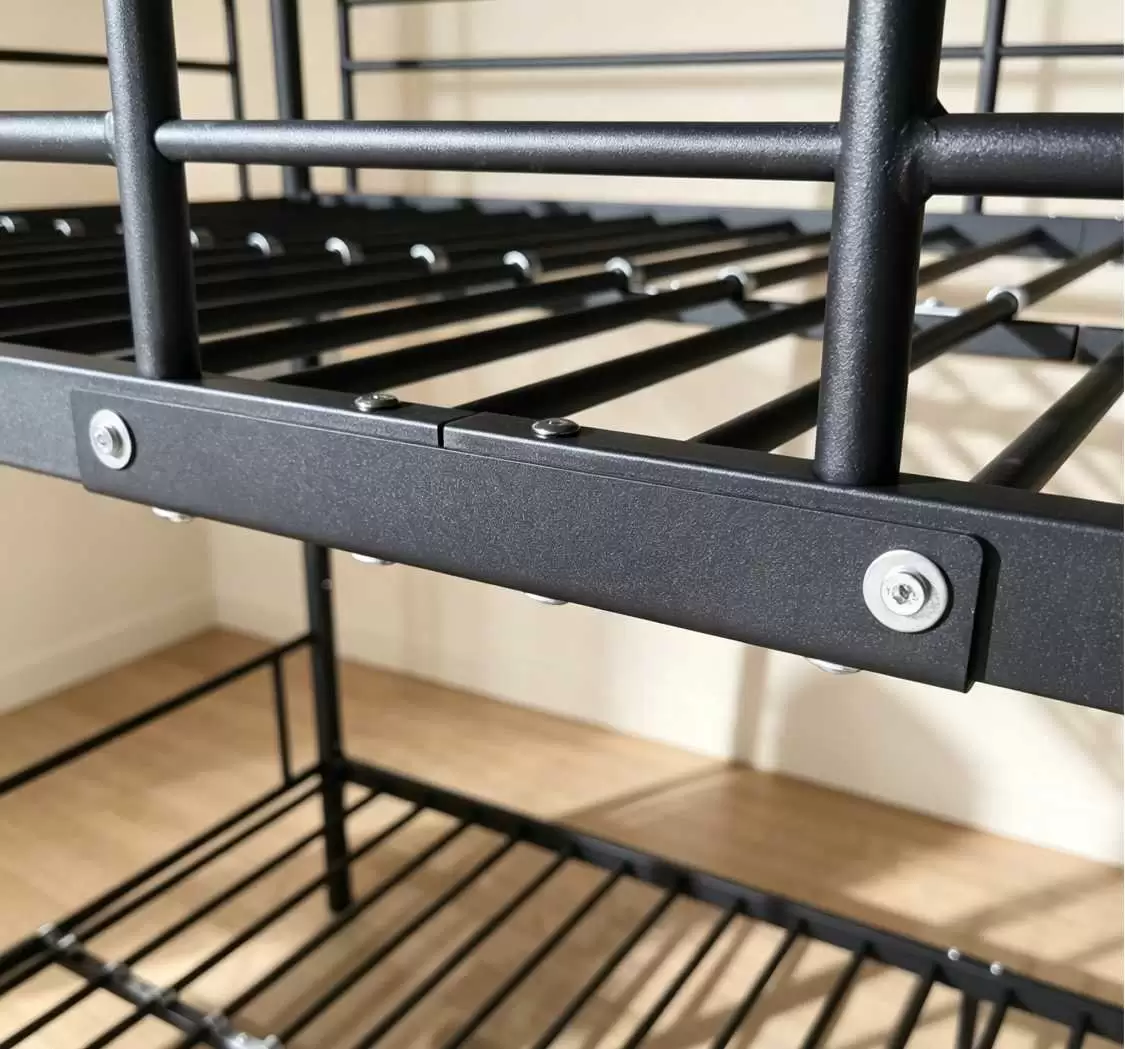
Bolted side-rail connector: the KD joints are the load path tested under EN 747-2 static and durability loading.
Because every joint is a bolted connection, assembly on site needs only basic hand tools, and individual parts can be replaced in service instead of scrapping a whole frame — a practical point for dormitory operators and rental programs. The bunk also converts into two standalone single beds, giving end users layout flexibility.
Which Markets Ask for EN 747 Bunk Beds?
EN 747 is the benchmark European buyers use for bunk beds: distributors in the EU and UK typically require an accredited test report before listing a product, and institutional projects (student housing, staff accommodation, refugee and social housing programs) commonly cite it in tenders. Our tested model was, in fact, submitted for a German import partner's program.
Applicability boundary: other regions set their own requirements — Australia and New Zealand, for example, apply AS/NZS 4220, which is a different test regime. EN 747 compliance does not automatically mean compliance with AS/NZS 4220. Tell us your destination market and we will confirm which test evidence applies before you order.
How to Verify a Supplier's EN 747 Report (5 Checks)
Not every "EN 747 certified" claim online holds up. Before you commit to a supplier, run these five checks:
- Report number and laboratory. A genuine report has a unique number (e.g. 70.404.23.12820.01) issued by an accredited lab such as TÜV SÜD, SGS or Intertek — not a self-declared "certificate".
- Standard version. The current edition is EN 747-1:2012+A1:2015 with EN 747-2:2012+A1:2015 test methods. Older versions or a missing "+A1:2015" suffix deserve a question.
- Model match. The report names the tested model and its dimensions. Confirm the model quoted to you is the model tested, not "a similar one".
- Tested sample photos. Ask for photos of the actual sample from the lab report and compare them with production units.
- Full report copy. We provide the complete report to qualified buyers on request — a supplier who only offers a logo or a one-page summary may not hold the full document.
Manufacturing Behind the Certificate
A test report is a snapshot of one sample; production consistency is what protects your order. Tianjin Zehao Furniture manufactures this bunk bed on fully in-house lines — tube cutting, welding, powder coating and packing — with a capacity of 8,000 metal beds per month and ISO 9001 quality management. EN 1725 and CE documentation for related bed models is also available.
The same platform ships contract and institutional programs across Europe, Africa, the Middle East and Southeast Asia, including a 5,000-set refugee housing project in Germany and 1,500 prison bunk beds delivered to Guinea in 2024. For project-grade alternatives, see our dormitory bunk beds and prison and correctional bunk beds pages, or browse the full metal bunk bed range.
Frequently Asked Questions: EN 747 Bunk Beds for Bulk Buyers
What is EN 747 for bunk beds?
EN 747 is the European safety standard for bunk beds and high beds. EN 747-1:2012+A1:2015 sets the safety, strength and durability requirements, and EN 747-2:2012+A1:2015 defines how they are tested — entrapment gaps, guard rail height, static loads, impact, fatigue cycles and stability.
Is EN 747 mandatory for selling bunk beds in Europe?
There is no single EU-wide "bunk bed directive" that names EN 747, but it is the recognized harmonized benchmark: EU and UK distributors, procurement tenders and institutional buyers routinely require an accredited EN 747 test report as market evidence. Without one, listing a bunk bed with European resellers is difficult in practice.
What loads does the EN 747 test apply to a bunk bed?
Key values in our report: 1,200 N static load and 10,000-cycle 1,000 N durability on the bed base, a 25 kg impactor dropped from 180 mm, 200–1,000 N multi-directional loads on the safety barriers, and 1,200 N static loading on ladder treads. All passed.
Can the EN 747 bunk bed be shipped flat-packed?
Yes. It is a knock-down (KD) design that packs flat, two sets of bolted frames per carton system with 5-layer export cartons and foam corners. Net weight is 39.0 kg per set, which keeps container utilization high.
What is the MOQ and lead time for EN 747 certified bunk beds?
Standard MOQ is 50 sets; sample orders of 1–5 sets are accepted and sample fees are refundable against orders of 100 sets or more. Lead time is 25–30 working days after deposit. Custom colors (RAL) and OEM carton printing are available at volume.
Does EN 747 cover Australia or North America?
No. Australia and New Zealand use AS/NZS 4220 for bunk beds, and North American buyers typically reference ASTM standards. EN 747 is the European benchmark. Confirm your destination market with us and we will advise which test evidence your program needs.
Further reading: Bunk Bed Load Capacity Standards: EN 747 Explained and EN 747 vs EN 1725: Bunk Bed Standards for Europe.
Request the Full TÜV SÜD Report and a Quotation
We share the complete EN 747 test report (report No. 70.404.23.12820.01) with qualified buyers, together with the SGS 200 kg per-berth load test and our ISO 9001 certificate. Send us your quantity, destination port and mattress size, and you will receive a formal quotation with container loading calculation within 24 working hours.
Contact: zehao@cntjzh.com · WhatsApp: +86 155 1090 8182
Last updated: September 2026. Test results relate to the tested sample; contact us for the current production specification.
: verified load, guard rail and ladder data, KD packing and bulk supply terms.)