
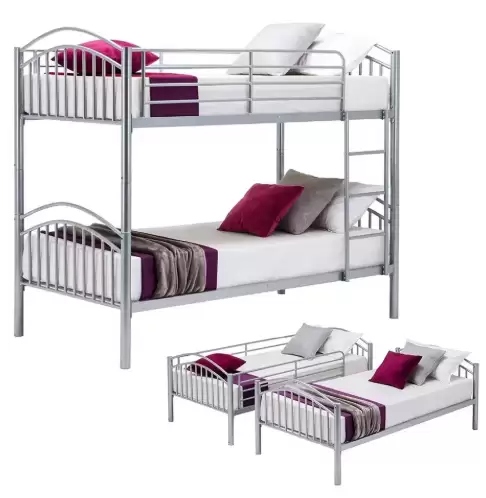
Corrosion is the quietest line item on a furniture tender — and the costliest one to get wrong. The AMPP (formerly NACE) IMPACT study puts the global cost of corrosion at roughly US$2.5 trillion a year, about 3.4% of global GDP. In a coastal dormitory, a mining camp or any high-humidity site, a liquid-painted steel frame can show rust at the welds inside 12–18 months. The fix is not a thicker coat of paint. It is writing the finish as a real specification instead of a one-word line that says "powder coated".
That single word hides four separate decisions. Get them down on paper and you stop buying a finish you cannot verify. Here is the spec our own B2B buyers use for steel bunk beds headed for salt air, dust and washdown environments.
When the finish is the whole warranty
Steel furniture fails from the outside in. A frame that carries a 200 kg SGS load test on day one can still be condemned in year two if the coating opens at a weld or a punched hole. Three environments punish finishes hardest: marine and coastal air, classified C5-M under ISO 12944-2; mining and construction camps, where dust and high-pressure washing abrade the surface; and unventilated tropical housing, where condensation sits on the metal overnight. If your project touches any of them, the coating — not the gauge — is what keeps a 10-year asset from becoming a 2-year one.
Paint versus powder, in one paragraph
Liquid paint flows away from sharp corners. Edges, welds and punched holes end up thin or bare, and that is exactly where rust starts. Electrostatic powder coating does the opposite: the powder is charged and drawn to the metal, then baked at 180–200°C to melt into a continuous film that wraps edges and seals them. That is why a proper powder coat routinely outlasts paint in the same environment. The catch is that "powder coated" only performs when the steps before and after it are done correctly.

The four decisions inside “powder coated”
1. Pre-treatment, not primer
Powder sticks to clean, converted steel. The frame must pass through degreasing, then phosphating (or shot blasting for heavier sections) before coating. Skip the phosphate and the coating still looks fine at the dock — then lets go in six months. Write the pre-treatment sequence into the spec and ask for the process card, not a photograph of the line.
2. Film thickness, measured
For durable institutional furniture, specify a dry film thickness of 60–100 µm, measured with a coating thickness gauge on a set number of points per frame. Thin at a weld is a defect. A triple bunk bed or a welded prison frame has more edges than a flat panel, so thickness at edges — not the average — is the number that matters.
3. Salt-spray hours, on a report
Ask for a neutral salt-spray report to ISO 9227 (or ASTM B117), and read the hours. A 500–1000 hour pass on a flat coupon is a different claim from a pass on a finished frame with welds and cut edges. Pin the test to the assembly, not the sample panel. Pair it with a cross-cut adhesion test so you know the film grips the steel, not just that it survived the fog.
4. Cure and cure control
Under-cured powder is soft and weak; over-cured powder goes brittle and chalks. Both failures look identical in a photo. Specify a cure window (typically 180–200°C for the stated time) and ask how the line records it per batch. This is the control that separates an OEM ODM bunk bed factory from a job shop that paints to order.

The checklist to drop into a tender annex
| Spec item | Pass criterion |
|---|---|
| Pre-treatment | Degrease + phosphating (or shot blast), process card on file |
| Coating type | Electrostatic powder, polyester or epoxy-polyester |
| Dry film thickness | 60–100 µm, gauge-checked incl. edges |
| Salt spray | ISO 9227 (NSS) report on a finished frame |
| Adhesion | Cross-cut pass (ISO 2409) |
| Cure control | 180–200°C, recorded per batch |
| Sample approval | Finished sample signed off before mass production |
Pair the finish with the right frame
The coating only protects what it covers, so the frame choice still matters. An all-steel welded design has no timber, which means no EUDR due-diligence file from 30 December 2026 and no swelling, splitting or fastener loosening in damp air — see the steel-versus-wood comparison for the full trade-off. For mining camps specifically, a flat-packed welded frame with a dense 40HQ load — typically 80–140 berths depending on configuration — keeps freight predictable on remote-site deliveries. Our mining-camp bunk bed guide walks through that loading math.
On commercial terms, write the MOQ (50–200 units for welded institutional frames) and the 25–40 day lead time into the purchase order, and ask for the certificate set up front: EN 747 / AS/NZS 4220 structural compliance, the SGS 200 kg load test, ISO 9001, and the salt-spray report for this batch. The full set is on our certifications page.
Specifying bunk beds for a coastal, mining or humid-site project? Download the full catalogue or message us on WhatsApp / email. We will send drawings, the salt-spray and SGS test reports, and a container-loading sheet within two working days. Browse more industry notes or start a wholesale enquiry.
