
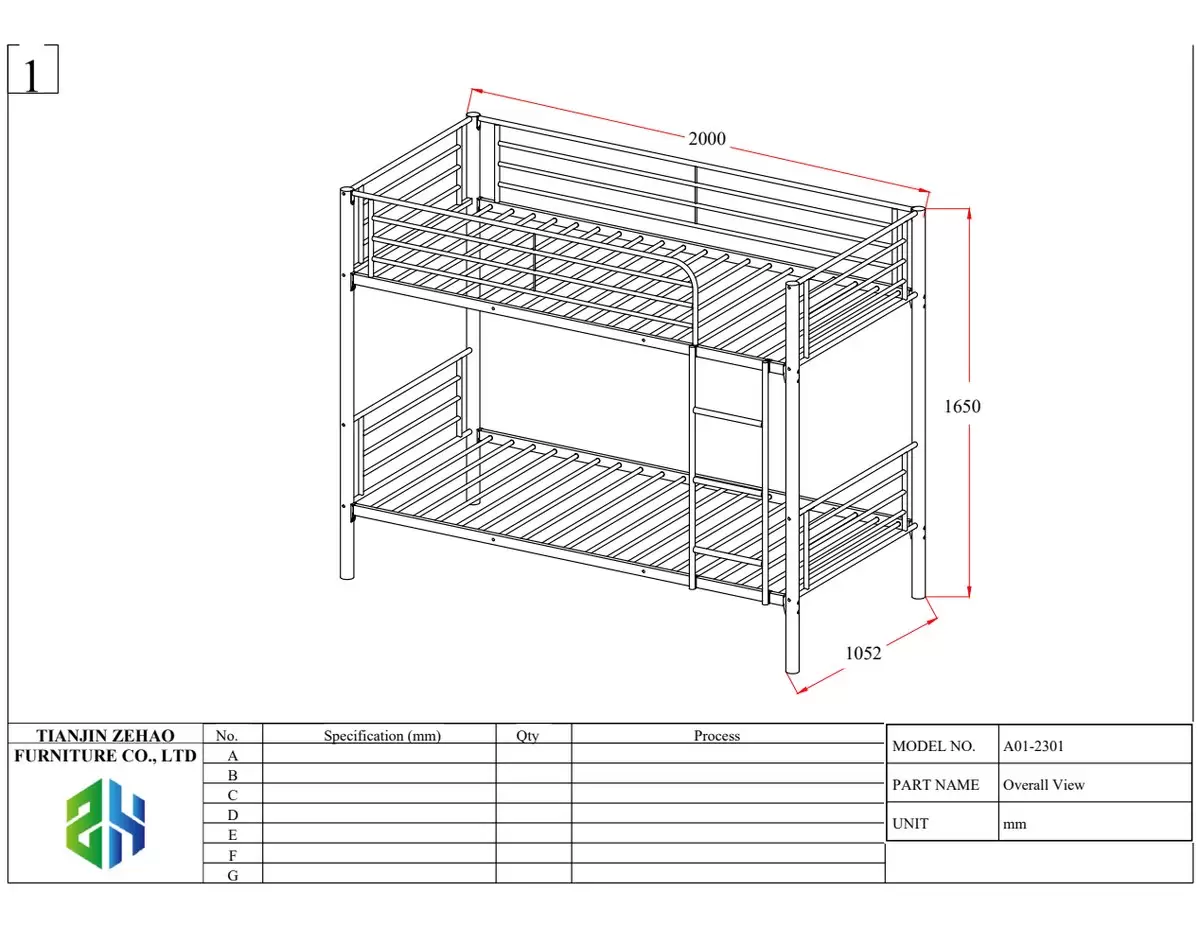
Every steel bunk bed that leaves our factory starts as an 11-sheet engineering drawing set — one sheet per component, with tube specifications, hole positions, welding requirements and assembly jigs defined to the millimetre. This is how Tianjin Zehao Furniture turns a buyer’s requirement into a product that assembles correctly the first time, in any country.
Most bunk bed suppliers show photos. We believe B2B buyers — importers, project contractors, institutional procurement teams — should also see what sits behind the photos: the engineering documentation that decides whether 500 beds arrive complete, fit standard mattresses, and go together without rework. Below is the actual drawing package for our steel bunk bed range, standard double bunk bed model A01-2301.
What a Professional Bunk Bed Drawing Set Includes
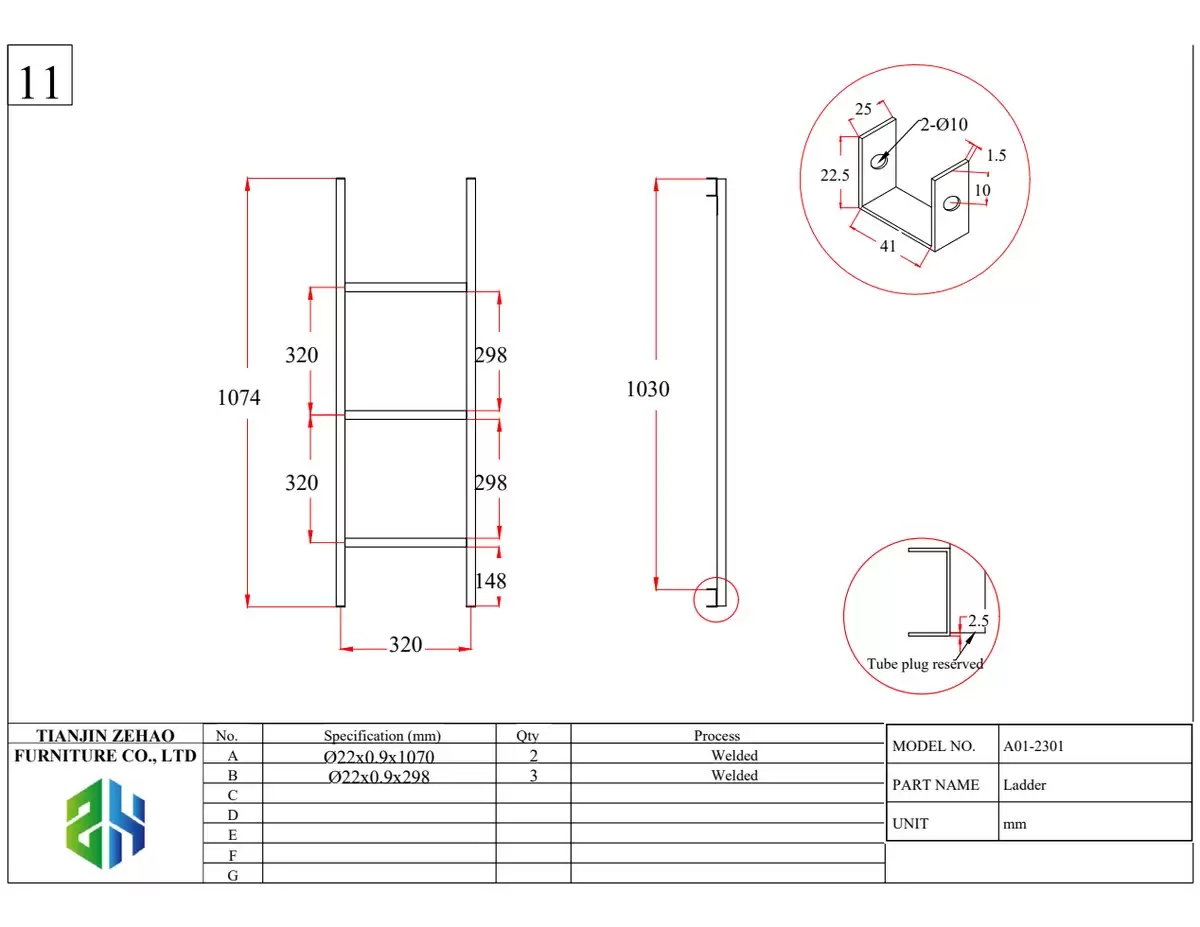
The A01-2301 package contains a general arrangement drawing plus ten individual component drawings. Each sheet carries the same title block: model number, part name, unit, and a parts table listing specification (mm), quantity and process. One bed breaks down into bed posts, frame rails, guardrail assemblies, headboard and footboard frames, 40 steel bed slats and a ladder — every part documented.
| Sheet | Part | Steel Specification | Process Notes |
|---|---|---|---|
| 1 | Overall view | 2000 × 1052 × 1650 mm | General arrangement, fits 1900 × 900 mm mattress |
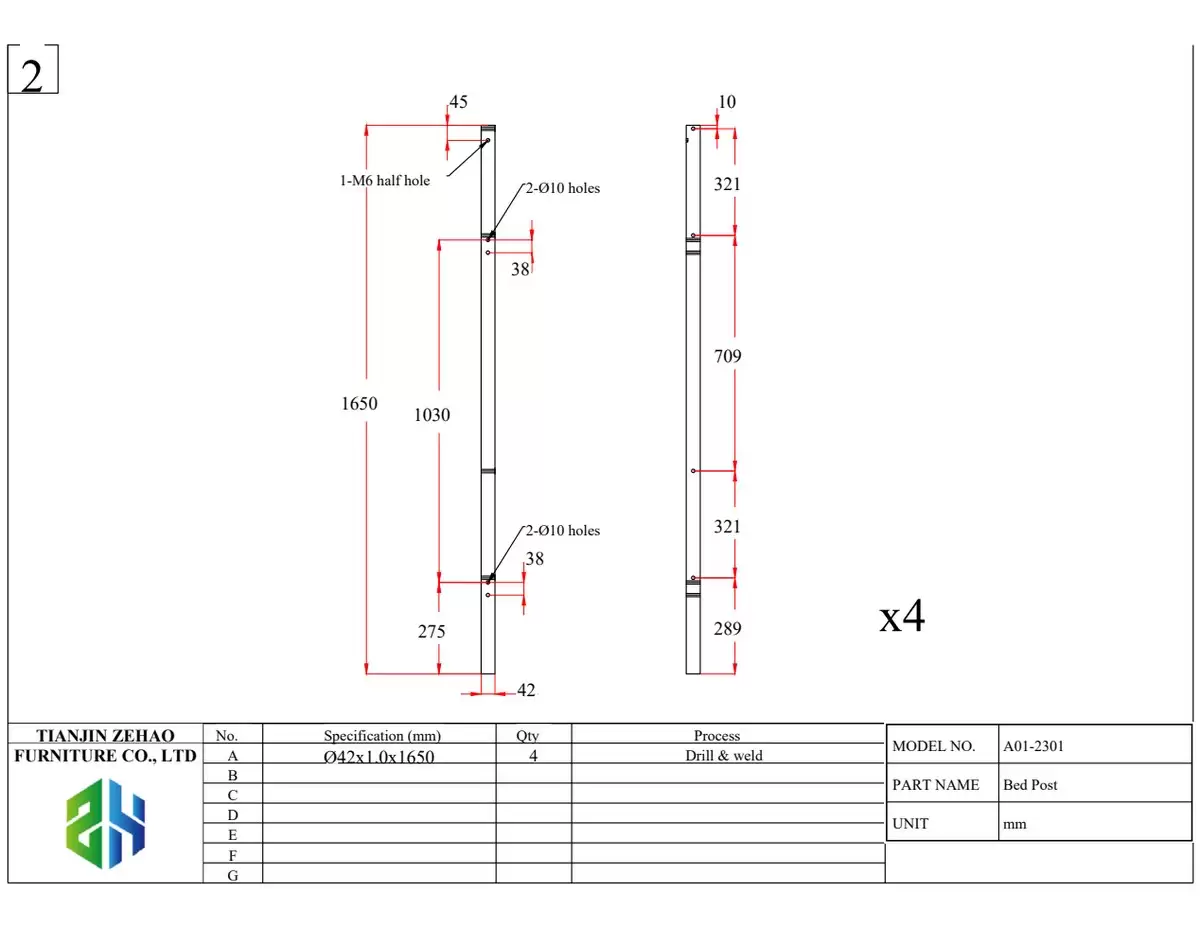
| 2 | Bed post × 4 | Ø42 × 1.0 mm tube, 1650 mm | Drill & weld; M6 half-hole, Ø10 hole positions dimensioned |
| 3–6 | Frame rails × 4 | 20 × 40 mm rectangular tube, 0.8 mm wall, 1894 mm | Punched; M8 tapped holes, Ø10 and Ø12.5 half-holes located |
| 7 | Short guardrail | Ø19 × 0.8 mm + Ø16 × 0.6 mm tubes, Ø6 steel strip | Bend radius R25; M6 nuts inserted; acid drain holes |
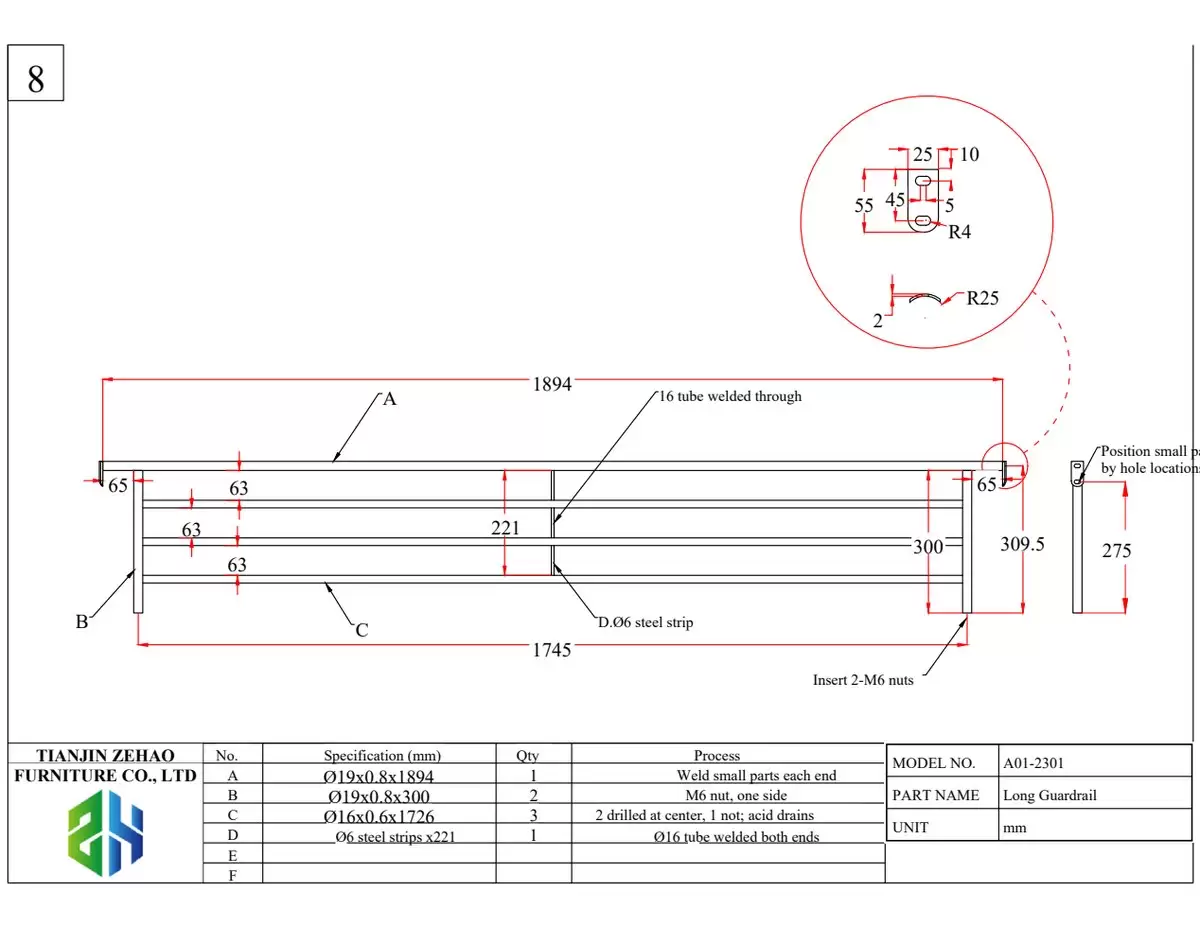
| 8 | Long guardrail | Ø19 × 0.8 mm + Ø16 × 0.6 mm tubes, Ø6 steel strip | Nuts inserted per jig; weld ends after bending |
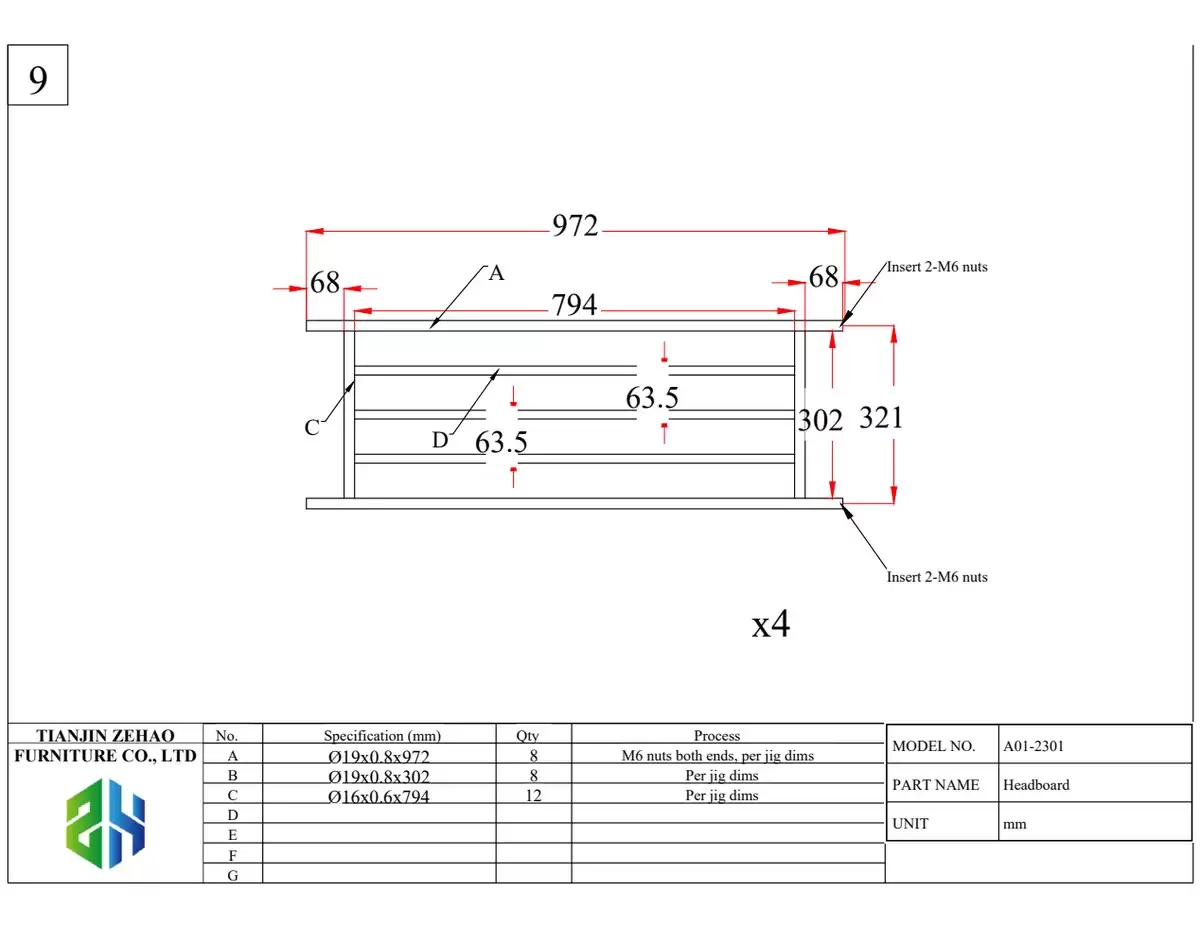
| 9 | Headboard / footboard × 4 | Ø19 × 0.8 mm + Ø16 × 0.6 mm tubes | All hole positions “per jig dims” — produced on welding jigs |
| 10 | Bed slats × 40 | Ø16 × 0.6 mm tube, 1027 mm | 36 plain + 4 with M6 nuts both ends for ladder/rail fixing |
| 11 | Ladder | Ø22 × 0.9 mm tube | Rungs at 320 mm spacing; mounting bracket 2-Ø10 holes; tube plugs reserved |
Details We Control Before the First Weld
A drawing set is only as good as the details on it. Three examples from the A01-2301 package:
- Hole positions are dimensioned, not estimated. The bed post drawing locates every M6 half-hole and Ø10 hole (45 mm, 38 mm, 275 mm from reference faces), so posts, rails and guardrails line up across thousands of units — not just the first sample.
- Jig-based production is written into the drawing. Headboard parts are marked “per jig dims” and small parts “position by hole locations”. Components are welded in fixtures, which keeps interchangeability high and makes flat-pack (knock-down) assembly predictable for your local team.
- Small features prevent big problems. Guardrail tubes carry acid drain holes so water never pools inside; bends are specified at R25 so tubes don’t crease; ladder tube ends are reserved for plugs so no open section is left exposed. M6/M8 nuts are inserted before coating, so no welding or retapping happens on site.
From Your Requirement to Mass Production: Our 4-Step OEM Process
This same drawing capability is what powers our OEM/ODM service for dormitory and camp projects. Customization is not a slogan — it follows the same engineering path as our standard models:
- Requirement — you send us dimensions, a sketch, a tender specification, or a physical sample. Non-standard mattress sizes, extra guardrail height, floor-mounting plates for correctional facilities, triple-deck configurations: all start here.
- Drawing — our engineers produce the full component drawing set and confirm tube thickness, ladder position, guardrail height and colour with you. Nothing enters production unsigned.
- Sample — a pre-production sample (1–5 sets) is built for your approval before bulk tooling.
- Mass production — with jigs set to the approved drawing, standard orders ship in 25–30 working days after deposit; larger custom projects in 30–35 days. Monthly capacity: 8,000 metal beds across two plants.
Drawings Backed by Certified Testing
Engineering on paper is verified by third-party testing. Our bunk beds are tested to EN 747 and EN 1725 (European bunk bed and bed-base safety standards), with SGS-tested 200 kg load capacity per bunk, and production runs under an ISO 9001 quality system. CE certificates are available for bed models, and third-party pre-shipment inspection is welcome.
Proven on Institutional Projects
The same design-to-drawing-to-delivery workflow has carried us through demanding institutional programs: 665 triple-deck steel bunk beds plus 1,050 mattresses for a UNDP-supported prison project in Malawi (with a 315-bed reorder the following year), and 1,500 heavy-duty steel bunk beds shipped in six containers to a correctional facility project in Guinea, featuring reinforced mesh bases and anti-tip floor fixing. From student dormitories and worker camps to correctional tenders, the drawing set is where every one of those projects began.
Planning a dormitory, camp or institutional bunk bed project? Send us your requirements or drawings — our engineers will return a complete technical proposal with specifications, drawings and a quotation.
Frequently Asked Questions
Can you manufacture bunk beds from our own drawings or samples?
Yes. We regularly produce from customer drawings, tender specifications, reference photos or physical samples. Our engineers redraw the design into a full component drawing set for your confirmation before any steel is cut.
What information do you need to start a custom bunk bed design?
Ideally: overall dimensions, mattress size, number of tiers, load requirement, finish colour, and any mandatory standards for your market. A sketch or a competitor’s model photo is enough for a first proposal — we confirm the engineering details with you at the drawing stage.
Do we see and approve technical drawings before production?
Always. Drawing approval is a required step in our process. Production jigs are set only after the customer signs off on the drawing set and the pre-production sample.
What is the MOQ for a custom-sized bunk bed?
Standard models: 50 sets. Fully customised sizes or colours carry a higher MOQ depending on the change. Sample orders of 1–5 sets are accepted, and the sample fee is refundable when the bulk order reaches 100 sets.
How long does a custom project take from drawing approval to shipment?
Standard bulk orders: 25–30 working days after deposit. Customised or extra-large projects: typically 30–35 days, depending on tooling and quantity.
Can you adapt beds to local mattress sizes outside China standards?
Yes. Our standard internal frame fits 1900 × 900 mm mattresses, and the drawing set is adjusted to your local mattress standard — this is precisely what the engineering stage exists for.
Last updated: September 18, 2026
